Jean Barré
PhDone !!! at:
Laboratoire Lattice, CNRS & ENS-PSL, Paris
Supervised by:
Thierry Poibeau and
Thomas Conrad
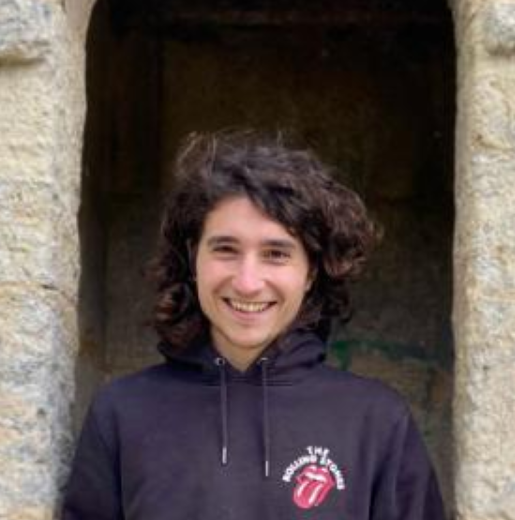
I work in Computational Literary Studies, combining literary theory with NLP and machine learning to study how narrative forms emerge, circulate, and change across large digital archives.
My PhD, Modeling Genre Literature: Computational Methods and Genre Evolution in French-Language Fiction, focuses on popular narrative fiction from the late nineteenth to the first half of the twentieth century, with a particular interest in detective and adventure subgenres.
Using large-scale corpora, vector-space models, and network analysis, I trace long-term shifts in textual patterns and character archetypes, such as the emergence and transformations of the detective figure.





Research Interests
Recent Updates
« Modéliser la littérature de genre », study day on AI & Digital Humanities (Oct. 15)
Hors d’usage: Curated French Fiction from Gallica, 1800–1950
TL;DR on Bluesky
Jury includes Marie-Ève Thérenty, Matthieu Letourneux, Evelyn Gius, Claire Barel-Moisan & Ted Underwood
Software & Projects
 Propp-fr
A tailored NLP pipeline for processing 19th and 20th century French literature. Adapts BookNLP for French novels, including named entity recognition, long coreference resolution, and character attributes extraction.
Website | Publication
 Refined Gallica Corpus
A curated corpus of 11,344 French novels from Gallica (BnF's digital library), cleaned and processed for computational literary analysis. Includes metadata enrichment, OCR quality filtering, and two genre-specific sub-corpora (adventure and detective fiction).
Website | Paper | Zenodo | Adventure sub-corpus | Detective sub-corpus
 Research Replication Materials
Code and data for reproducing key findings from my publications:
Operationalizing Canonicity | Latent Structures of Intertextuality | Detective Archetype
Featured Publications
Barré, J. ; Seminck, O. ; Bourgois, A. ; Poibeau, T. (2025). Conference on Computational Humanities Research (CHR2025).
Proceedings | arXiv | PDF | Github
This figure shows all the detectives in our corpus as dots in a map built from their character embeddings—numerical fingerprints that summarize the verbs, adjectives and nouns most often used around their name in the novels. Three main clusters emerge: one brings together the early, very rational “puzzle-solver” detectives of the late 19th and early 20th century, another groups the more human, empathic investigators of the interwar and mid-century period (like Maigret), and a third contains the later hardboiled and néo-polar detectives, whose language is more physical, colloquial and tied to social violence. The fact that nearby dots tend to come from similar publication years shows that these clusters trace a historical trajectory: as the way authors write about detectives changes, their embeddings drift across the map and form these three successive generations of the archetype.
Cite this work
@article{barre_detectives_2025,
          title = {Modeling the Construction of a Literary Archetype: The Case of the Detective Figure in French Literature},
          author = {Jean Barré and Olga Seminck and Antoine Bourgois and Thierry Poibeau},
          year = {2025},
          journal = {Anthology of Computers and the Humanities},
          volume = {3},
          pages = {983--999},
          editor = {Taylor Arnold, Margherita Fantoli, and Ruben Ros},
          doi = {10.63744/SMbYIWcHZj87},
          }
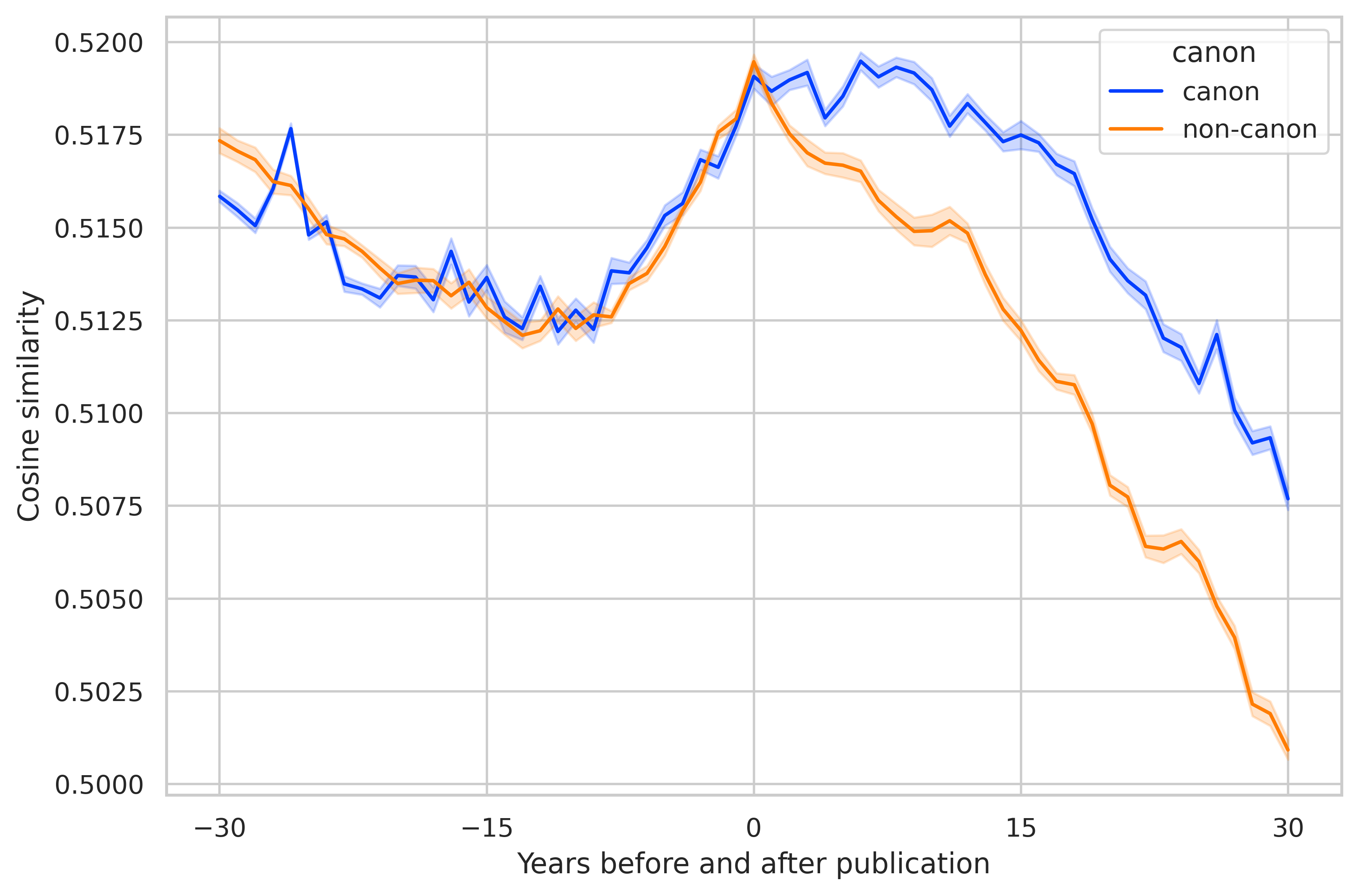
Barré, J. (2024). Conference on Computational Humanities Research (CHR 2024), Aarhus, Denmark.
Proceedings | ArXiv | PDF
Cite this work
@inproceedings{barre_latentstructuresintertextuality_2024,
        location = {Aarhus},
        title = {Latent Structures of Intertextuality in French Fiction},
        rights = {Creative Commons Attribution 4.0 International},
        eventtitle = {{CHR} 2024},
        pages = {21--26},
        booktitle = {Proceedings of the Computational Humanities Research Conference 2024},
        author = {Barré, Jean},
        date = {2024},
        url={https://ceur-ws.org/Vol-3834/paper97.pdf},
        keywords = {notion, Computation and Language (cs.{CL}), {FOS}: Computer and information sciences},
        }
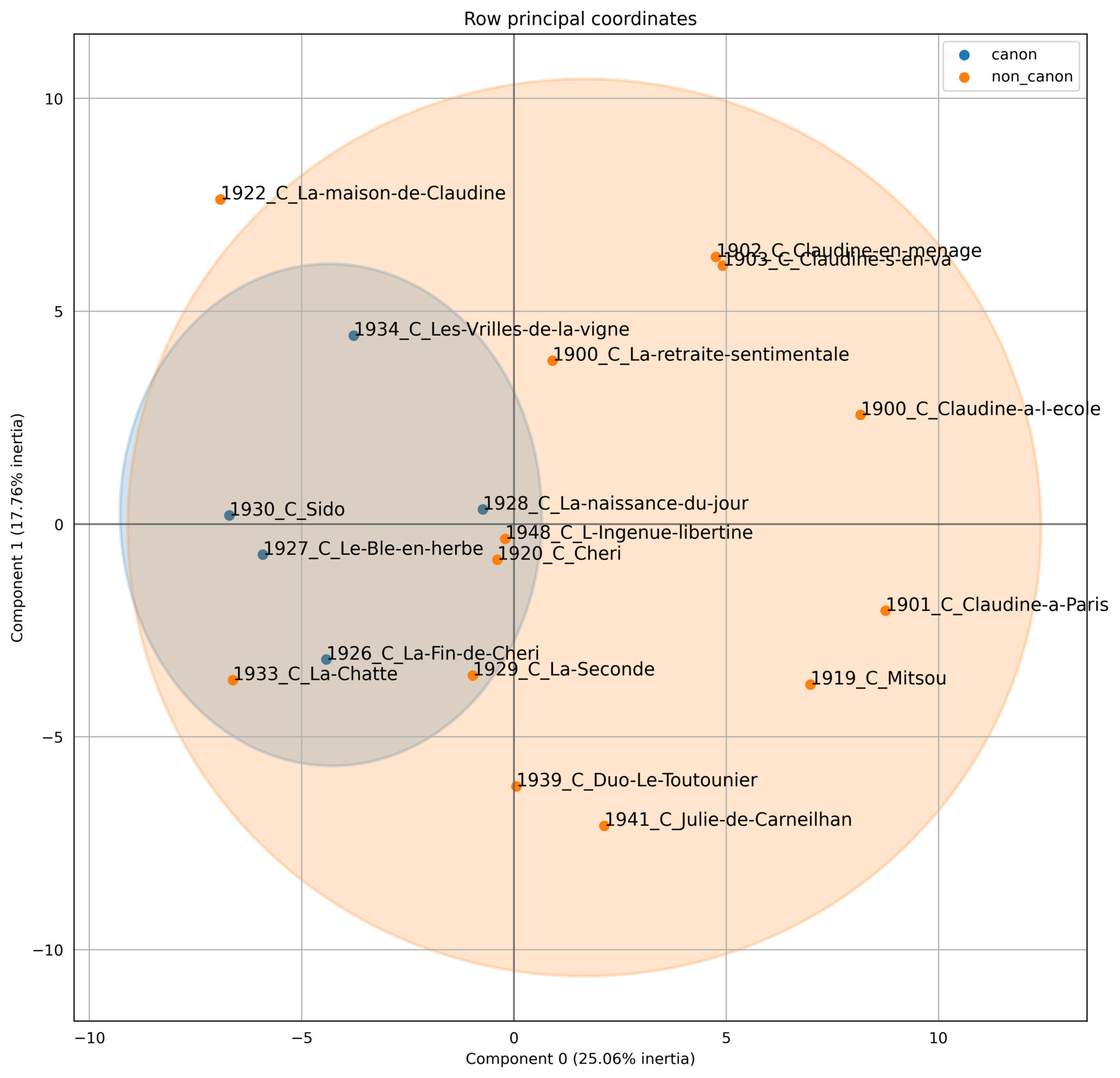
Barré, J. ; Camps, JB. ; Poibeau, T. (2023). Journal of Cultural Analytics, 8(1).
DOI | PDF
Cite this work
@article{barre_operationalizingcanonicityquantitative_2023,
          	title = {Operationalizing Canonicity: A Quantitative Study of French 19th and 20th Century Literature},
          	volume = {8},
          	doi = {10.22148/001c.88113},
          	shorttitle = {Operationalizing Canonicity},
          	pages = {1--29},
          	number = {1},
          	journaltitle = {Journal of Cultural Analytics},
          	author = {Barré, Jean and Camps, Jean-Baptiste and Poibeau, Thierry},
          	date = {2023},
          	langid = {english},
          	keywords = {canon},
          }